
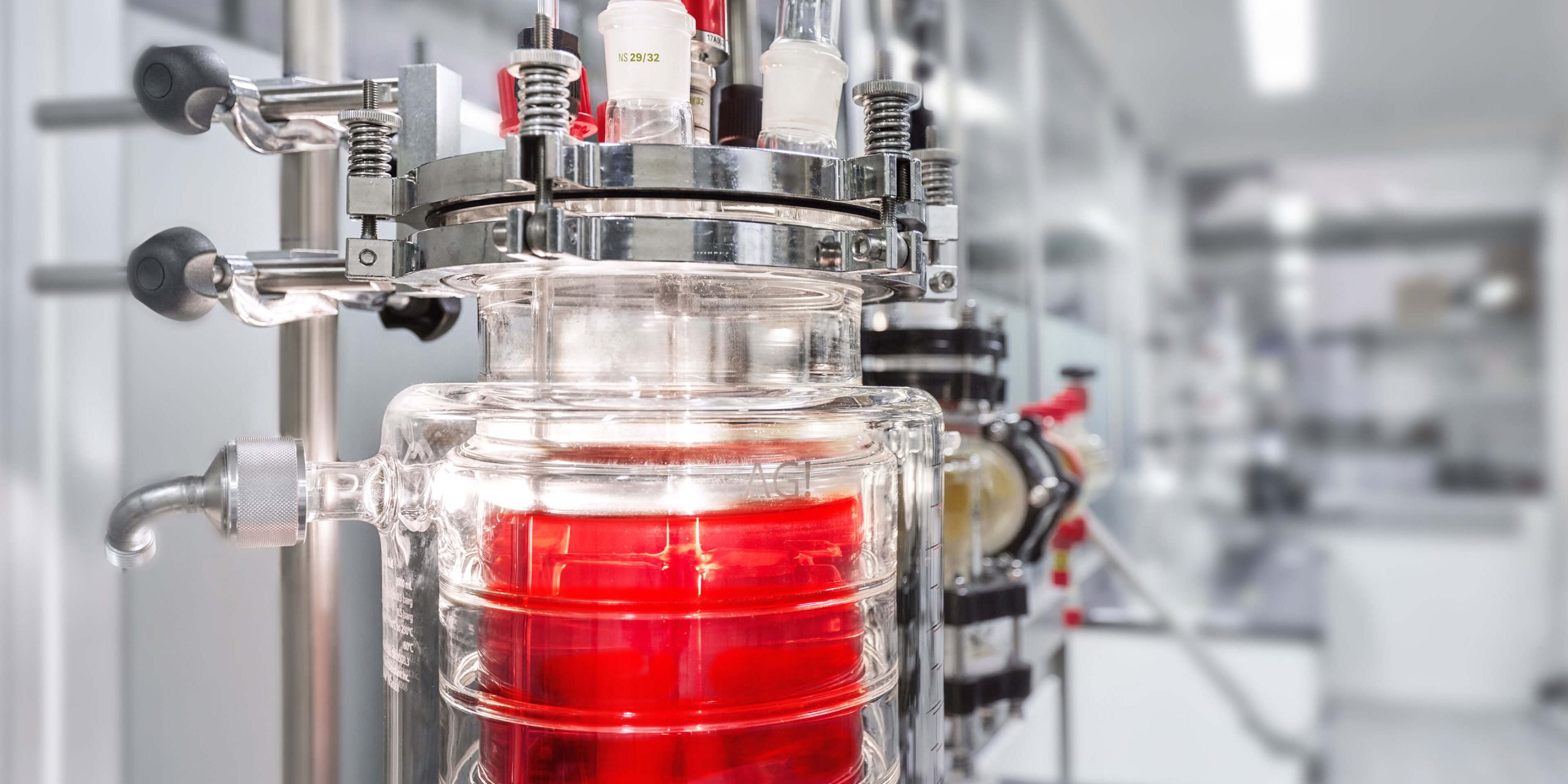
Why jacket behaviour defines temperature control performance in chemical processing
Temperature control is one of the most influential variables in chemical processing. Whether the goal is to maintain a stable reaction environment, drive a crystallisation profile, or achieve predictable thermal transitions during scale up, the behaviour of the reactor jacket plays a decisive role in process performance.
At GlasKeller – part of the AGI Group – we’ve spent decades refining the geometry, flow paths, and thermal behaviour of jacketed glass reactors. Every vessel we manufacture is engineered for optimal circulator flow, efficient heat transfer, and stable temperature control.
Within the AGI Group, however, an additional technology exists for processes that demand the highest level of thermal uniformity: Ring Baffle, a proprietary jacket enhancement developed by AGI Japan and available on select GlasKeller reactors.
Understanding the Ring Baffle concept
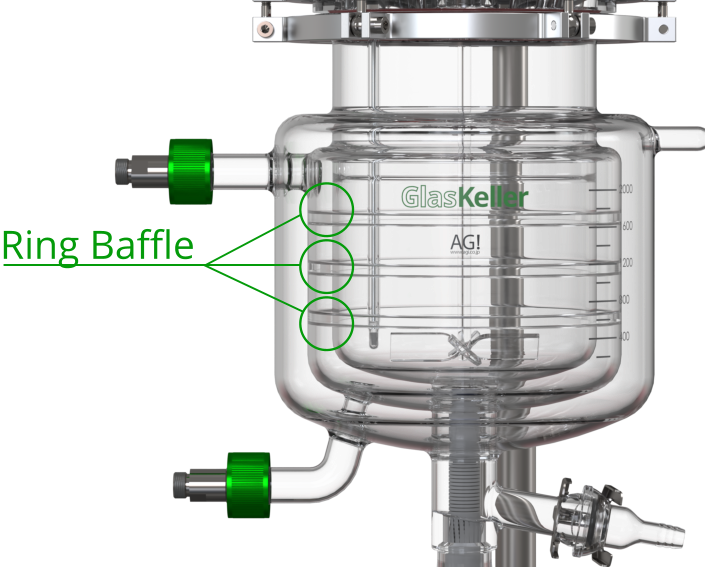
A conventional smooth walled jacket allows thermal fluid to circulate freely, but this flow is not always uniform. Channeling can occur, where fluid preferentially follows certain paths while other regions experience reduced movement. This leads to temperature gradients across the vessel wall, which in turn affect heating and cooling rates, reproducibility, and the overall efficiency of heat transfer.
Ring Baffle addresses this by incorporating a series of precisely formed glass ridges into the jacket wall. These structures interrupt laminar flow, redistribute the thermal fluid, and promote a more turbulent and uniform movement throughout the jacket. The effect is similar to upgrading a simple cavity into a more controlled and efficient heat exchange environment.
Flow behaviour and thermal uniformity
Visual flow studies conducted within the AGI Group illustrate the impact of Ring Baffle clearly. When a dye is introduced into the jacket of a Ring Baffle vessel, it disperses rapidly and evenly, indicating consistent fluid movement across the entire surface. In contrast, the same test performed on a smooth jacket reveals uneven dispersion and areas where the dye lingers, highlighting the presence of channeling.
Thermal imaging studies reinforce these observations. Under identical heating conditions, Ring Baffle vessels achieve a uniform temperature distribution across the jacket wall far more quickly than smooth jacket vessels. The latter typically show persistent hot and cold regions, even after extended operation. This uniformity is not merely visual—it directly influences the stability and predictability of the process inside the vessel.
Heat distribution performance as shown by thermal imaging data
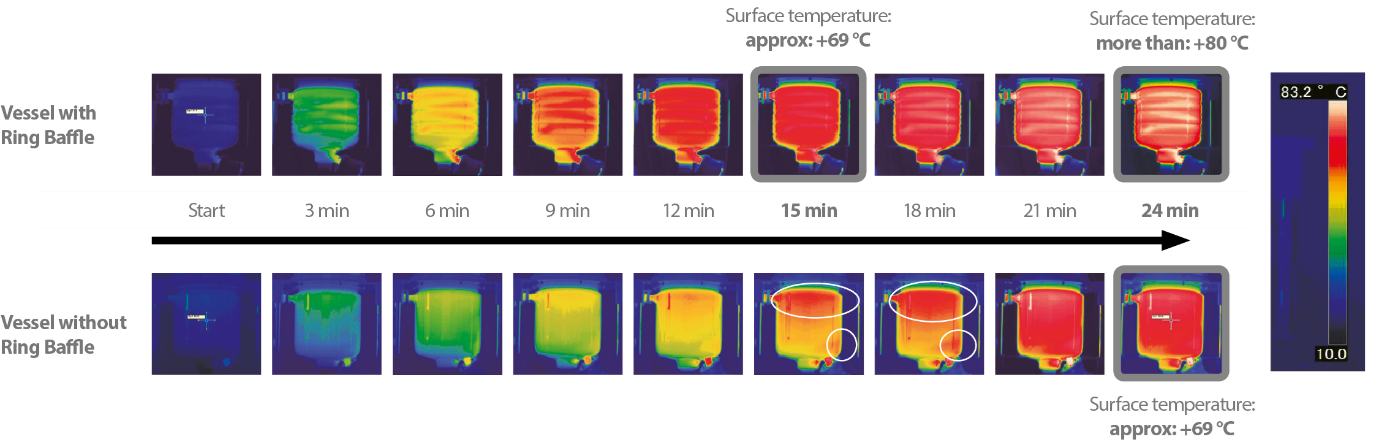
The thermal images compare two identical vessels—one with Ring Baffle and one without—heated under the same conditions. The Ring Baffle vessel reaches a uniform wall temperature from around the 15 minute mark, showing even distribution of thermal energy. The smooth jacket vessel continues to display hot and cold spots throughout the test. This clearly demonstrates the superior heat distribution efficiency provided by Ring Baffle technology.
Performance across scales and applications
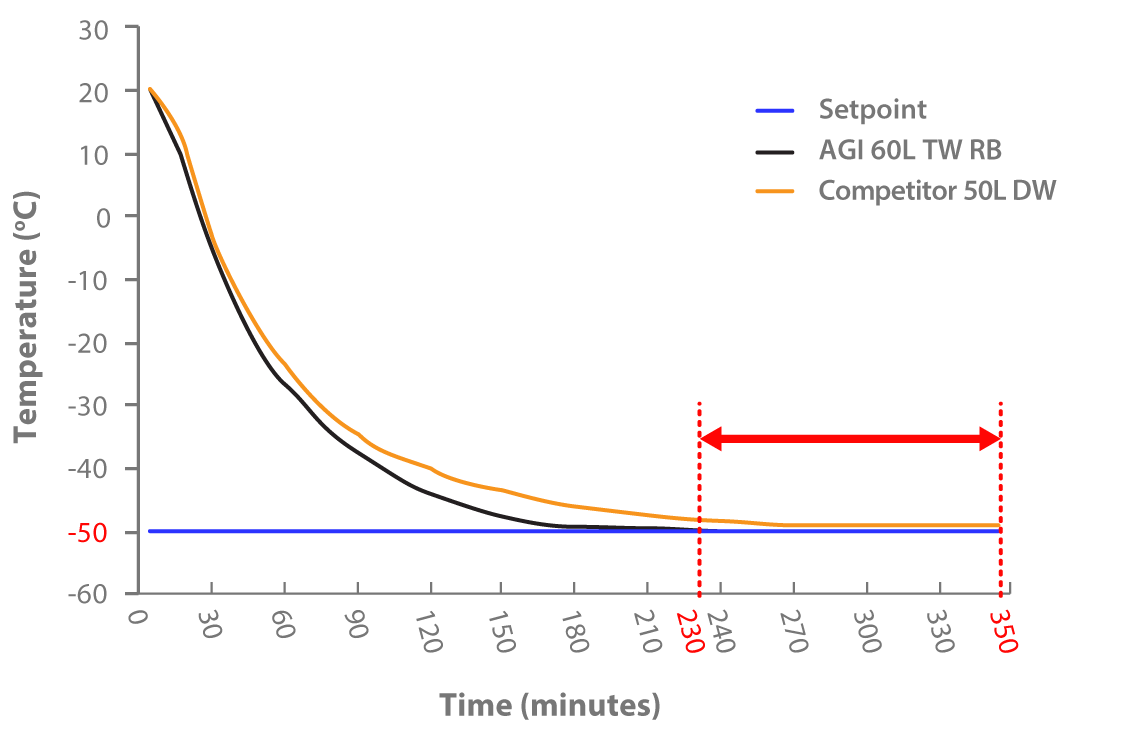
Ring Baffle technology has been evaluated across multiple reactor sizes, from benchtop systems to pilot scale vessels. In cooling studies, Ring Baffle reactors consistently reach target temperatures significantly faster than their smooth jacket counterparts. For example, a 60 L triple wall Ring Baffle reactor has been shown to reach a (-50 °C) setpoint more than two hours faster than a comparable smooth jacket vessel, despite the latter having a smaller working volume. Similar advantages are observed at the 1 L scale, demonstrating that the effect is not dependent on reactor size.
AGI Triple Wall Ring Baffle 60 L Reactor vs Competitor Standard Double Wall 50 L Reactor
Cool 120 mins faster
AGI Triple Wall Ring Baffle 1 L Reactor vs Competitor Standard Double Wall 1 L Reactor
Cool 30 mins faster
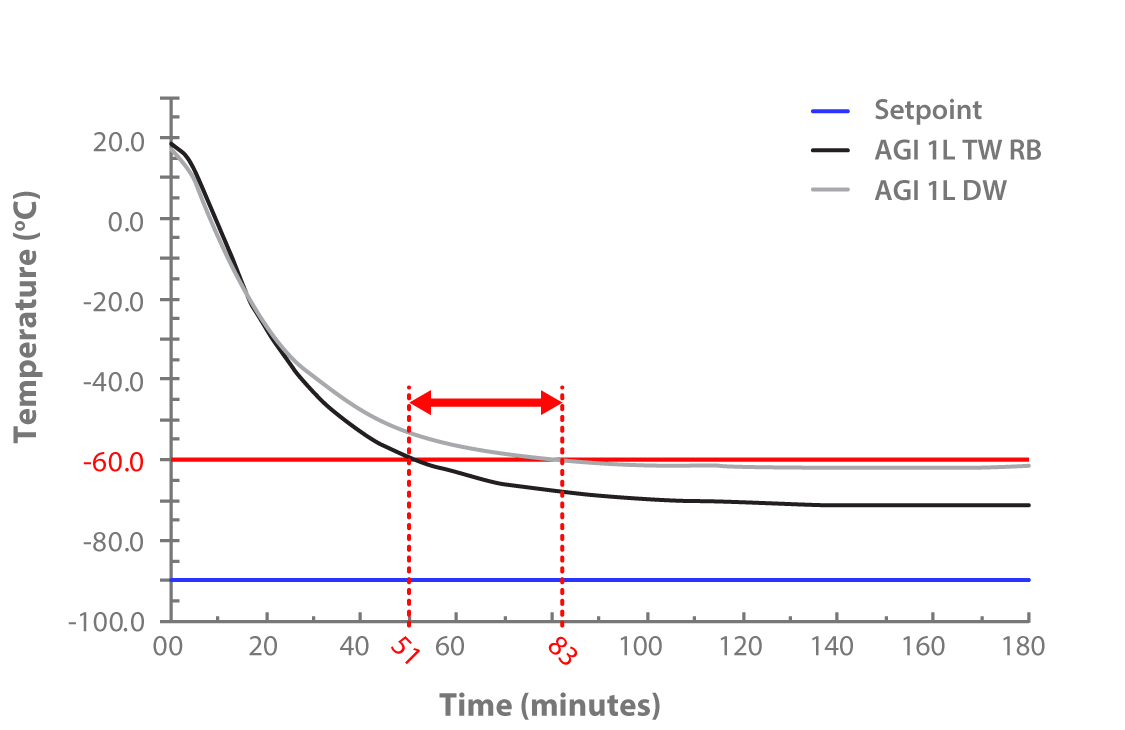
Heat‑transfer efficiency studies conducted at FHNW Muttenz further quantify this behaviour. When subjected to an endothermic load, Ring Baffle reactors exhibit a higher temperature differential between jacket inlet and outlet across all tested flow rates. This indicates more effective energy exchange and a greater capacity to respond to thermal demands.
Why GlasKeller offers Ring Baffle
As part of the AGI Group, GlasKeller has access to the full suite of AGI’s proprietary technologies, including Ring Baffle. While all GlasKeller reactors are designed to deliver strong thermal performance through optimised geometry and jacket design, Ring Baffle provides an additional level of control for processes where temperature uniformity is critical.
This makes it particularly valuable in applications such as crystallisation development, temperature sensitive reactions, and scale up studies where reproducibility and thermal responsiveness directly influence process outcomes.
Ring Baffle is available across a range of GlasKeller and AGI Group reactor platforms, including benchtop, pilot, and universal reactor systems, with multiple vessel volumes supported.
A practical enhancement for demanding thermal processes
Ring Baffle is not a cosmetic feature; it is a functional enhancement that changes how the jacket behaves and how the process responds. By improving flow distribution, increasing turbulence, and eliminating temperature gradients, it enables faster thermal transitions, more efficient heat transfer, and more stable process control.
For users seeking the highest level of temperature performance in a glass reactor, Ring Baffle technology provides a proven and technically robust solution.


